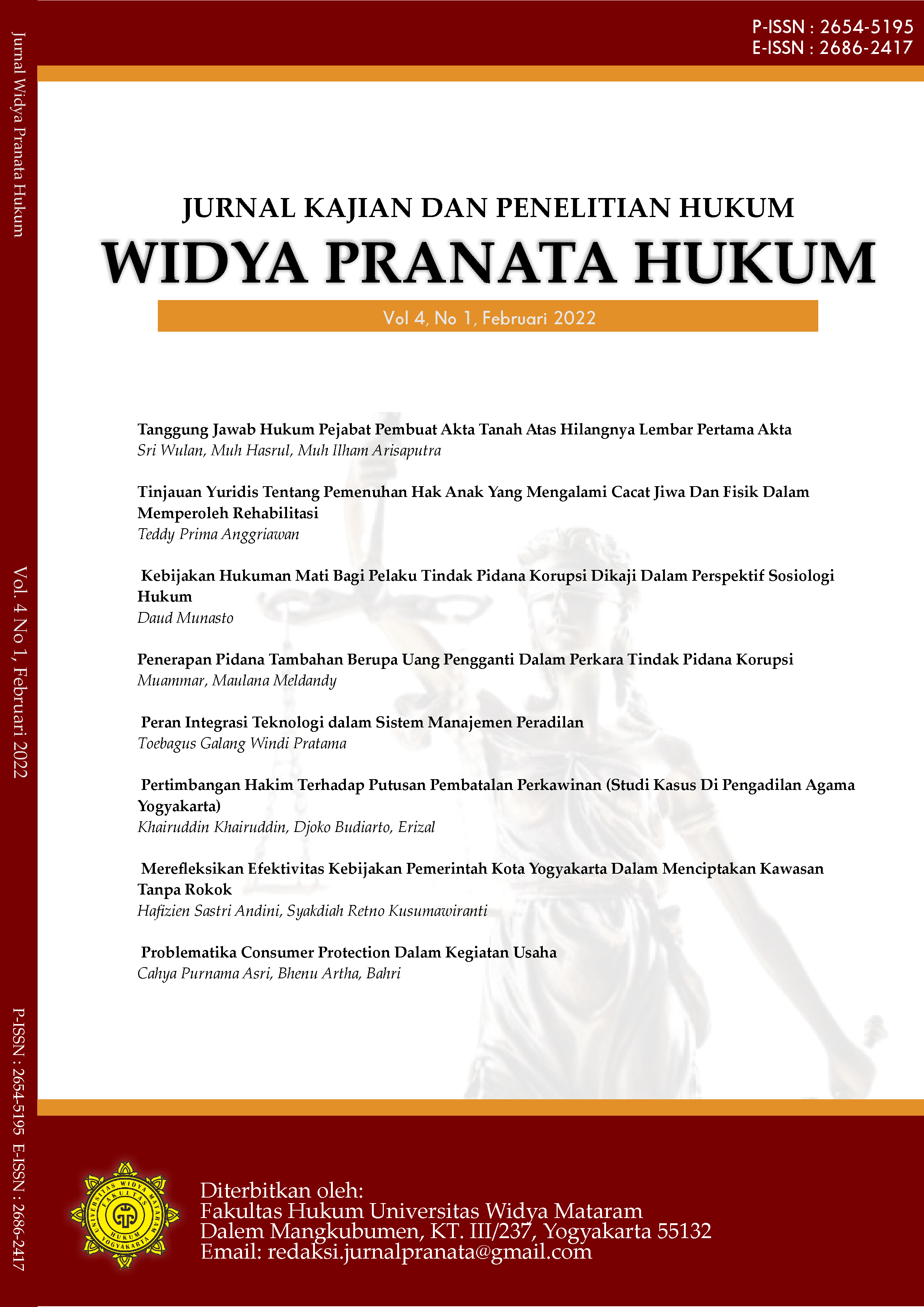
The Policy Of The Death Penalty For Perpetrators Of Corruption Is Studied From A Sociological Perspective Of Law
DOI:
https://doi.org/10.37631/widyapranata.v4i1.541Keywords:
Kata kunci, Tindak Pidana Korupsi, Sanksi Pidana Mati, Perspektif Sosiologi Hukum.Abstract
Corruption as an extraordinary crime provides regulations regarding the death penalty for the perpetrators. However, the fact is that this provision has never been applied by judges in adjudicating corruption cases. Therefore, corruption continues to occur and has expanded both the mode and the perpetrators. The formulation of Article 2 paragraph (2) UUTPK relating to "emergency conditions" is difficult to fulfill its elements. The formulation of the word "can be sentenced to death", provides an opportunity for judges to impose other heaviest criminal alternatives that are not in the form of a crime of loss of life opportunity, namely imprisonment for a certain period of time; or a maximum of 20 years or life imprisonment. The purpose of this study is to determine and explain the quality of the policy formulation of capital punishment for criminals. The research method used is normative juridical, the research specification is descriptive analysis, data collection techniques through library research. The results of this study are first, a review of the sociology of capital punishment for perpetrators of criminal acts of corruption. Efforts to tackle corruption must be carried out thoroughly both for law enforcers of corruption crimes and must be completely free from the intervention of any party with a legal sociology approach.
Keywords: Corruption Crime; Death Penalty Sanctions; Legal Sociology Perspective.
References
Adji Indriyanto Seno. 2002. Korupsi & Hukum Pidana. Jakarta: Kantor Pengacara &Konsultasi Hukum “Prof.Oemar Seno Adji, SH & Rekan.
Agustina Shinta. 2014. Asas Lex Specialis Derogat Legi Generali Dalam Penegakan Hukum Pidana. Depok: Themis Books
Amirudin dan Zainal Asikin. 2004. Pengantar Metode Penelitian Hukum. Jakarta:PT. Raha Grafindo PersadaAli, Zainuddin. 2008. Sosiologi Hukum. Sinar Grafika.
Aziz Syamsudin,2011. Tindak Pidana Khusus, Jakarta:Sinar Grafika.
Hiariej, E. Q.2009. Asas Legalitas & Penemuan Hukum Dalam Hukum Pidana. Jakarta:Erlangga.
Rahardjo, Satjipto. 2010. Sosiologi Hukum. Genta
Publishing. Yogyakarta
Chazawi, Adami, 2016, Hukum Pidana Korupsi di Indonesia, Jakarta:
PT.Rajagrafindo Persada
Hamzah Andi .2012. Pemberantasan Korupsi Melalui Hukum Pidana Nasional dan Internasional. Jakarta: PT. Rajagrafindo Persada
John Rawl sebagaimana dikutip dalam Marwan Effendy, 2014, Teori Hukum Dari Perspektif Kebijakan, Perbandingan, dan Harmonisasi Hukum Pidana, Jakarta: Referensi
Rifai Ahmad. 2011. Penemuan Hukum Oleh Hakim Dalam Perspektif Hukum
Progresif. Jakarta: Sinar Grafika Offset.
Soekanto Soerjono.2005. Pengantar Penelitian Hukum, UI-Press, Jakarta,
Sudirman, A. (2015). Eksistensi Pidana Minimum Khusus Sebagai Sarana Penanggulangan Tindak Pidana Korupsi. Jurnal Masalah-Masalah Hukum, 44(3), 316–325.
Brian Rahantoknam,â€Pidana Mati Bagi Koruptor†Jurnal Lex Crimen Vol 2, No 7 (2013) ISSN: 2301-8569
Helmi Muammar, Wawan Kurniawan,dkk.â€Analisa Peraturan Mahkamah Agung Nomor 1 Tahun 2020 tentang Pedoman Pemidanaan kaitanya dengan Asas Kebebasan Hukum dalam Tindak Pidana Korupsi†Widya Pranata Hukum : Jurnal Kajian dan Penelitian Hukum Vol 3, No 2 (2021) ISSN (Online) 2654-5195- 2686-2417 DOI prefix 10.37631 by
Oksidelfa Yanto, Penjatuhan Pidana Mati Pelaku Tindak Pidanakorupsi Dalam Keadaan Tertentu( Death Penalty To Corruptors In A Certain Condition ),Jurnal Legislasi Indonesia Vol. 14 N0. 01 - Maret 2017 :Hlm 49 – 56
ook Mufrohim, Imam Subaweh, Joko Setiyono,â€Pidana Mati Terhadap Tindak Pidana Korupsi Dimasa Pandemi Covid 19†Mahkamah (Jurnal Kajian Hukum Islam) ISSN: 2355-0546 (print), ISSN: 2502-6593 (online)
Utomo, D. S. . ; N. W. . ; S. (2017). Penjatuhan Pidana Bersyarat Bagi Koruptor Dalam Perspektif Upaya Pemberantasan Tindak Pidana Korupsi Di Indonesia. Jurnal Pasca Sarjana Hukum UNS, (2), 101–116.
Warih Anjari,â€Penerapan Pidana Mati Terhadap Terpidana Kasus Korupsiâ€Jurnal Masalah-Masalah Hukum Undip. Vol 49, No 4 (2020) DOI: 10.14710/mmh.49.4.2020.432-442
Zaid Alfauza Marpaung. “Kebijakan Hukuman Mati Bagi Pelaku Tindak Pidana Korupsi Dalam Perspektif Hukum Pidana Islamâ€.Jurnal Advokasi.Vol 7, No 1 (2019).DOI: https://doi.org/10.36987/jiad.v7i1.243
Media Indonesia. Resolusi Membunuh Korupsi. Retrieved January 7, 2019, from http://mediaindonesia.com/editorials/detail_editorials/1574-resolusi-membunuh-korupsi RI, (2019).
K. D. N. (2019). Mendagri: Korupsi diIndonesia Sudah Akut. Retrieved January 11, 2019, fromhttps://www.kemendagri.go.id/index.php/blog/27805-Mendagri-Korupsi-di-Putra, Indonesia-Sudah-Akut.
S. Dian Andryanto, “Heru Hidayat Dituntut Hukuman Mati, ini Landasan Hukuman Mati bagi Koruptorâ€, https://nasional.tempo.co/read/1537342/heru-hidayat-dituntut-hukuman-mati-ini-landasan-hukuman-mati-bagi-koruptor.diakses Kamis, 9 Desember 2021 pukul 07:20 WIB
S. Dian Andryanto,â€Menakar Hukuman Mati Bagi Koruptor di UU No. 31/1999 tentang Tipikorâ€.
https://nasional.tempo.co/read/1489050/menakar-hukuman-mati-bagi-koruptor-di-uu-no-311999-tentang-tipikor.diakses diakses Senin 3 Januari 2022 pukul 14:45 WIB
Latuhar hary, “Komnas HAM: Hukuman Mati Bukan Solusi Pemberantasan Korupsiâ€https://www.komnasham.go.id/index.php/news/2021/3/12/1709/k omnas-ham-hukuman-mati-bukan-solusi-pemberantasan-korupsi.html, diakses Senin 3 Januari 2022 pukul 14:45 WIB
Chyntia Sami BhayangkaraBagaimana Aturan Hukuman Mati Bagi Koruptor di Indonesia? Bagaimana Aturan Hukuman Mati Bagi Koruptor di Indonesia? https://www.suara.com/news/2021/12/08/172124/bagaimana-aturan-hukuman-mati-bagi-koruptor-di-indonesia, diakses Senin 3 Januari 2022 pukul 14:45 WIB
Yuli nurhanisah, â€Hukuman Mati bagi Pelaku Korupsiâ€.https://indonesiabaik.id/infografis/hukuman-mati-bagi-pelaku-korupsi,diakses Senin 3 Januari 2022
Downloads
Published
Issue
Section
License
Copyright (c) 2022 Widya Pranata Hukum : Jurnal Kajian dan Penelitian Hukum

This work is licensed under a Creative Commons Attribution-ShareAlike 4.0 International License.
Jurnal Widya Pranata Hukum allows readers to read, download, copy, distribute, print, search, or link to the full texts of its articles and allow readers to use them for any other lawful purpose. The journal allows the author(s) to hold the copyright without restrictions. Finally, the journal allows the author(s) to retain publishing rights without restrictions

This work is licensed under a Creative Commons Attribution-ShareAlike 4.0 Generic License.